AI Image Restoration Explained: What Can and Can’t Be Fixed
Learn how AI image restoration works, what can realistically be fixed, and where limitations apply—handled with human review and privacy-first care.
2/1/20268 min read
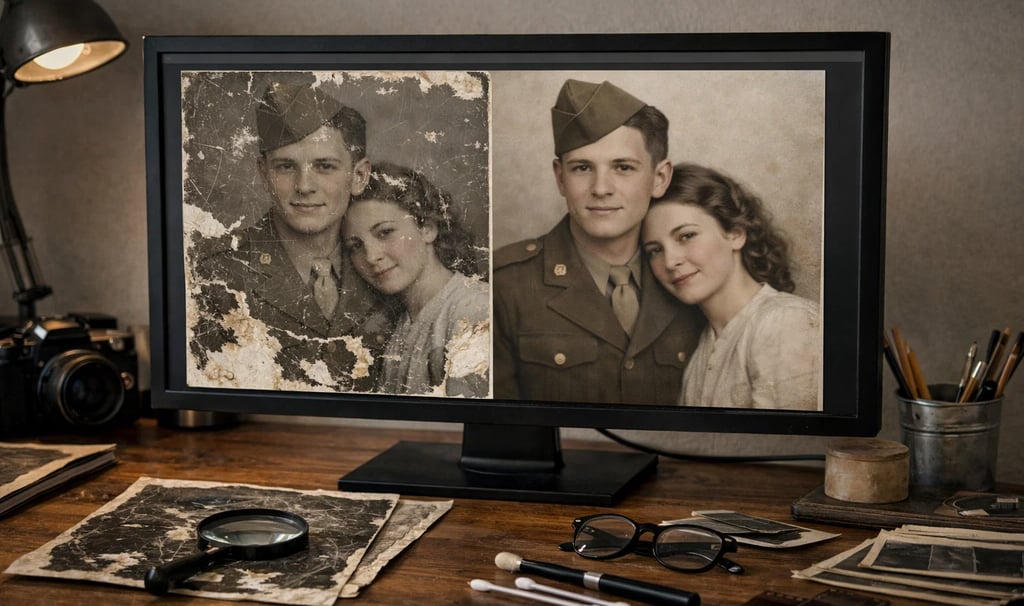
Understanding AI Image Restoration
AI image restoration refers to a process that utilizes artificial intelligence techniques to enhance and repair images, a capability offered through AI image restoration services designed to address common issues such as imperfections, distortions, and inconsistencies. At the core of this technology lies the implementation of machine learning algorithms and neural networks that analyze and interpret visual data, allowing for the repair and enhancement of images.
The process begins with the collection of a vast dataset of images, which the algorithm uses to learn various features and characteristics. By exposing the algorithm to diverse examples, it becomes adept at identifying patterns and anomalies in images.
Once trained, these algorithms can apply their learned knowledge to assess new images, identifying elements that require restoration. During this process, the algorithm evaluates different aspects of the image, including color fidelity, sharpness, and texture.
Neural networks, a subset of machine learning, play a crucial role in this restoration process. They function by mimicking the way the human brain processes information, making it easier for the technology to understand complex image structures. Convolutional Neural Networks (CNNs), in particular, are widely used in AI image restoration due to their proficiency in recognizing spatial hierarchies in visual data.
Common applications of AI image restoration include noise reduction, sharpening blurry images, and filling in missing data from damaged photographs. While AI can efficiently restore images in many contexts, there are inherent limitations.
For instance, if the original image contains minimal data or if significant context is missing, the restoration may not yield satisfactory results. Hence, while AI image restoration has made substantial advancements, it is essential to recognize that its capabilities are, at times, constrained by the quality and completeness of the original image.
Common Image Issues Addressed by AI
AI image restoration services are designed to tackle a variety of common issues that can compromise the quality of photographs. One prevalent problem is scratch removal.
Scratches on images can occur due to improper handling or aging of the medium, resulting in unsightly marks that disrupt the visual coherence of a picture. AI algorithms efficiently analyze and reconstruct the damaged areas, restoring the image to its original state.
Another typical issue that these services address is faded colors. Over time, photographs may lose their vibrancy due to exposure to sunlight and environmental factors. AI image restoration can rejuvenate these colors by employing advanced techniques to assess and replicate the original hues, significantly enhancing the overall appearance. This restoration process is particularly vital for preserving family heirlooms or historical documents.
Reducing blur is also a significant capability of AI image restoration technology. Blurriness can result from camera shake, improper focus, or movement during the shot. AI methods can identify the patterns of blur and apply corrections, sharpening the image and bringing back lost detail.
This technique is invaluable for restoring images that originally appeared unflattering or unclear.
Finally, mitigating noise is yet another challenge addressed by AI-powered restoration solutions. Noise typically manifests as graininess or pixelation in photographs, often stemming from low light conditions or high ISO settings. AI algorithms can analyze the noise pattern and differentiate it from the actual image content, effectively reducing unwanted artifacts while preserving the necessary details.
In summary, AI image restoration serves as a powerful tool in combating common image imperfections. By utilizing these advanced technological solutions, one can restore images that suffered from issues such as scratches, faded colors, blur, and noise, breathing new life into cherished photographs.
Setting Realistic Expectations
Artificial Intelligence (AI) image restoration has gained traction as a promising solution for enhancing and repairing damaged or poor-quality images.
However, it is crucial for users to set realistic expectations regarding what this technology can achieve. The effectiveness of AI image restoration is influenced by several factors, each playing a significant role in the outcome of the process.
The first factor to consider is the quality of the original image. If the initial photograph is very low resolution or heavily pixelated, AI algorithms may struggle to generate satisfactory results. In contrast, images that possess more detail and clarity prior to restoration tend to yield higher-quality remastered versions. Users should be aware that while AI can fill in gaps and enhance features, there are limitations in recreating details where none exists.
Another critical consideration is the extent of the damage to the image. Minor issues such as slight blurring or minimal scratch marks can often be corrected effectively, leading to significant improvements in visual appeal.
However, severe damage such as extensive color distortion or large missing sections can present significant challenges. In such cases, the AI might only partially restore the image, resulting in an overall appearance that may not meet user expectations.
The capabilities of the specific software utilized for AI image restoration also play a significant role in determining what can realistically be accomplished. Various tools on the market offer different features, processing algorithms, and levels of sophistication. Therefore, choosing the right solution is imperative for maximizing potential results.
By understanding these factors, users can better appreciate the strengths and limitations inherent in AI image restoration technologies. A well-informed perspective allows for realistic projections of what can be achieved, fostering a more satisfying experience when returning to beloved memories captured in images that may not stand the test of time.
Limitations of AI Image Restoration
AI image restoration has revolutionized the way we approach the recovery of damaged or low-quality images. However, it is essential to acknowledge that this technology is not a panacea. There are inherent limitations that can significantly impact the effectiveness of AI restoration techniques.
One of the primary limitations arises when the original image is excessively damaged. For instance, images that are significantly blurred or contain severe distortion may present challenges that are difficult for AI algorithms to overcome.
The algorithms rely on existing information to reconstruct missing or damaged details, and when the original data is inadequate, the results can be far from satisfactory. In such cases, the restoration might lead to artifacts or odd enhancements that do not accurately reflect reality.
Additionally, AI image restoration may struggle with images that lack sufficient data. For example, photographs taken in poor lighting conditions or those with considerable noise may limit the types of restorations achievable through AI methods.
This situation becomes particularly challenging when the underlying features are so obscured that the algorithm cannot predict what details are supposed to be present. When there is a significant lack of reference data, the restoration process may fail to recreate the integrity of the original image accurately.
Furthermore, certain artistic styles or unique textures in images may create obstacles for AI tools that are primarily designed for conventional restoration tasks.
The algorithms are not programmed to replicate every nuance of artistic expression and instead rely on statistical modeling. In scenarios where intricacy and artistic intention are crucial, the results of AI-based restoration can fall short. Thus, while AI image restoration is a powerful tool, understanding its limitations is vital for setting realistic expectations about what can be effectively restored.
The Importance of Human Review
Despite the advances in AI image restoration technology, the importance of human review remains paramount. AI systems can analyze and process images at an impressive speed, potentially restoring lost details, correcting distortions, and enhancing overall quality. However, these systems are not infallible and often require the insight and expertise of human reviewers to achieve the best results.
Human intervention serves multiple functions in the context of AI-driven image restoration.
First, while AI algorithms can detect and correct certain types of image degradation, they lack the nuance to understand the emotional or historical significance embedded within certain visuals.
Experts can provide context that allows them to identify which details are truly worth restoring. For instance, a photograph that has faded over decades might contain special sentimental value that needs careful preservation, which is something AI might overlook.
Furthermore, AI can sometimes introduce artifacts or errors into the image during the restoration process. These anomalies—whether due to misinterpretation of pixels or insufficient training data—can compromise the integrity of the restored image.
Human reviewers can identify these issues, scrutinizing the AI-generated outputs for accuracy and authenticity. They ensure that the final product aligns with the expectations and standards required for professional use, thus maintaining the credibility of the restored images.
The collaboration between machine intelligence and human oversight not only enhances the quality of the restored images but also instills a sense of trust in the outcomes.
As AI continues to evolve, it is crucial to remember that human skills and expertise will remain indispensable in ensuring that technology serves as a valuable aid rather than a standalone solution. The dynamic interplay of AI technologies and human review ensures that image restoration can meet high standards of both quality and authenticity within a professional workflow.
Ethical Handling and Privacy Concerns
As the capabilities of AI image restoration technology expand, it raises significant ethical considerations that warrant careful attention.
The first aspect to address is data privacy. AI models often require access to vast datasets to learn and improve, which may include images containing personal or sensitive information. The unauthorized use of such images can infringe upon individuals' rights and violate privacy laws. Thus, obtaining consent from individuals whose images are to be processed is a fundamental ethical obligation. This ensures that their personal data is treated respectfully and in accordance with relevant regulations.
For details on how uploaded files are handled and deleted after delivery, see our Privacy Policy.
Professional services formalize these principles through clearly defined guidelines, such as a dedicated Consent & Acceptable Use Policy, to ensure responsible and lawful handling of submitted images.
Another critical concern is the potential for misuse of image restoration technology. The ability of AI to enhance or alter images can lead to deceptive practices, especially in contexts such as journalism or social media.
For instance, using AI to restore or enhance images in a misleading way can misrepresent facts, which may damage reputations or propagate false information. Consequently, ethical guidelines should be established within the context of image restoration practices, emphasizing transparency about the uses of technology and the contextual integrity of the images.
Furthermore, there are cases where images from vulnerable groups or sensitive situations are restored and publicly shared without proper consideration. In these instances, the use of AI image restoration techniques requires even more caution. Guidelines should be in place to protect the dignity and emotional well-being of individuals depicted in such images.
Practitioners of image restoration must navigate these waters with a strong ethical compass, balancing the technological possibilities with respect for individual rights.
When to Use AI Restoration Services
AI image restoration services have gained considerable popularity due to their ability to enhance and repair photos, particularly those that have suffered damage or degradation over time. However, utilizing these services effectively requires an understanding of when they are most appropriate. In general, AI restoration is best suited for images that are either faded, scratched, or have experienced some form of digital distortion.
These issues often arise due to age, environmental conditions, or improper storage of photographs. By leveraging advanced algorithms and machine learning techniques, AI can intelligently analyze the image data and produce high-quality results, thus reversing the effects of wear and tear.
On the other hand, it is crucial to recognize scenarios where AI restoration services may not be ideal. For instance, if the original image is overly pixelated or heavily distorted beyond recognition, AI systems may struggle to reconstruct meaningful details.
Similarly, images with significant color misbalance might resist correction without substantial manual intervention. Additionally, in cases where historical accuracy is paramount, relying solely on AI-generated modifications could lead to misleading representations of the original work.
Moreover, users should also consider the expectations associated with the restoration process. While AI can drastically improve image quality, it may not always replicate the exact appearance of the original photograph. Rather, it provides a reconstructed version that aims to retain the essence of the original visual narrative.
Therefore, users should approach AI restoration services with realistic expectations, especially when the images in question hold sentimental or historical significance.
FaceSwapMe
Private, consent-based AI face and media processing.
Every request is reviewed by a human operator and handled discreetly. Files are deleted after delivery.
© 2026. FaceSwapMe. All rights reserved.
Quick Links
Legal & Privacy
Contact & Availability
contact@face-swap.me
Response time: within 24–48 hours

No data is shared. No content is stored. No processing begins without approval.