How AI face swap works: from image upload to final result
Learn how AI face swap works step by step, from facial detection to final image processing, and why professional services improve results.
1/26/20263 min read
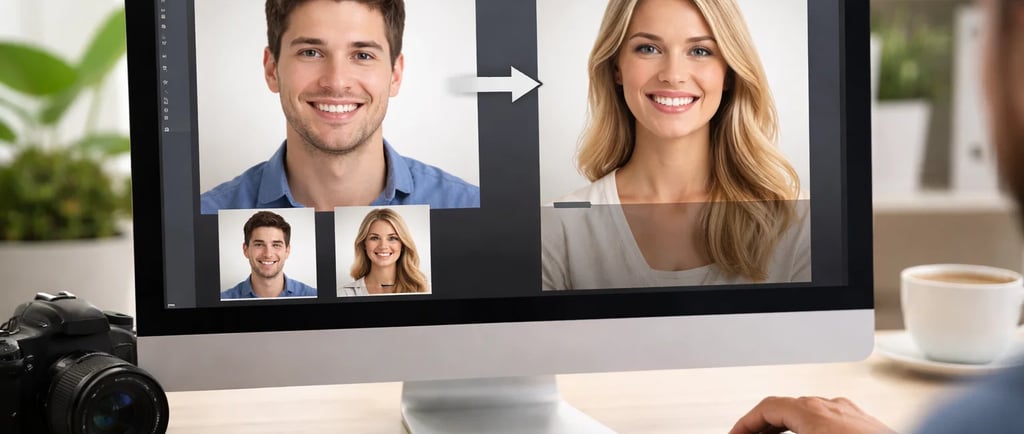
How AI Face Swap Works: From Image Upload to Final Result
The technical process behind face swapping highlights the differences between face swap tools vs professional services, particularly in how errors are detected and corrected.
AI face swap technology allows one person’s face to be replaced with another in an image or video while maintaining a realistic appearance. Although the results may look simple on the surface, the process behind them involves several precise technical steps. Understanding how AI face swap works helps explain why some results look convincing while others fall short—and why professional services consistently achieve better outcomes.
Understanding Face Swap Technology
AI face swap technology is built on advances in artificial intelligence and machine learning. Instead of manually editing images, modern systems rely on trained models that can recognise, analyse, and reconstruct facial features with high accuracy. These models study the structure of a face, including proportions, contours, and expressions, and then adapt that information to another image.
Face swap features became widely known through social media filters and entertainment applications, where users can instantly alter their appearance for fun or creative expression. Over time, the same technology has been adopted in professional contexts such as film production, advertising, and digital content creation, where realism and consistency are essential.
Many common face swap mistakes happen when automated systems fail to account for complex facial angles or inconsistent lighting conditions. At its core, AI face swap follows a structured pipeline: detecting faces, aligning them correctly, blending visual details, and refining the final result. Each step plays a critical role in how natural the outcome appears.
Step 1: Image Upload and Facial Detection
The process begins when images are uploaded. These images may contain one or multiple faces and serve as the source material for the swap. Once uploaded, the AI system scans the image to locate human faces.
Facial detection algorithms identify key landmarks such as eyes, nose, mouth, jawline, and facial contours. This step is crucial because accurate detection determines how well the face can be mapped onto another image. Poor detection can result in distorted proportions or misplaced features later in the process.
Advanced systems focus exclusively on facial data while ignoring backgrounds or irrelevant elements. This allows the AI to build a detailed facial profile that will be used throughout the remaining stages.
Step 2: Facial Mapping and Alignment
Once a face is detected, the system moves to alignment. Alignment ensures that the facial features of the source face match the position, scale, and orientation of the target face.
AI models calculate the spatial relationship between landmarks and apply transformations such as rotation, scaling, and repositioning. Even small inaccuracies at this stage can lead to unnatural results, such as misaligned eyes or uneven facial proportions.
Professional workflows pay particular attention to this phase, as it sets the foundation for a believable face swap. Accurate alignment ensures that expressions and angles are preserved rather than forced into place.
Step 3: Blending and Visual Integration
After alignment, the blending process begins. This stage focuses on merging the source face into the target image so that it appears visually consistent. The AI adjusts skin tone, texture, lighting, and shadow to ensure the swapped face matches its new environment.
Blending is often the most challenging part of the process. Differences in lighting conditions, image quality, or facial expression can make integration difficult. AI systems use advanced techniques to smooth transitions between skin areas and reduce visible seams.
Automated tools attempt to handle this instantly, but they often struggle with complex lighting or subtle texture differences. Professional services typically refine this step manually, correcting imperfections that automated systems may overlook.
Step 4: Refinement and Quality Control
The final stage involves refinement. This includes correcting minor inconsistencies, improving edge transitions, and ensuring the overall image looks coherent. Professional face swap services may perform additional checks to verify realism, balance, and visual integrity.
This stage is where professional services distinguish themselves most clearly. Human oversight allows for subjective judgement—something automated tools cannot replicate. Adjustments can be made based on context, intended use, and client feedback, resulting in a polished final image.
Why Professional Face Swap Services Deliver Better Results
While automated tools prioritise speed, professional face swap services focus on accuracy and reliability. Professionals understand how facial structure, lighting, and perspective interact, allowing them to correct issues that AI alone may not resolve.
Professional services are especially valuable when face swaps are used for marketing, events, or sensitive projects where quality matters. The ability to refine results, manage complex images, and ensure visual consistency leads to outcomes that are difficult to achieve through fully automated solutions.
Making Sense of the Process
AI face swap technology follows a clear sequence—from image upload and detection to alignment, blending, and refinement. Each stage contributes to the final result, and weaknesses at any point can affect realism.
Understanding how this process works makes it easier to evaluate different face swap options. Automated tools may be suitable for casual use, but professional services provide greater control, accuracy, and consistency when results truly matter.
FaceSwapMe
Private, consent-based AI face and media processing.
Every request is reviewed by a human operator and handled discreetly. Files are deleted after delivery.
© 2026. FaceSwapMe. All rights reserved.
Quick Links
Legal & Privacy
Contact & Availability
contact@face-swap.me
Response time: within 24–48 hours

No data is shared. No content is stored. No processing begins without approval.