Professional Face Swap Services vs DIY Tools: A Complete Comparison
Compare professional face swap services with DIY tools and learn which option delivers better quality, privacy, and reliability.
1/26/20263 min read
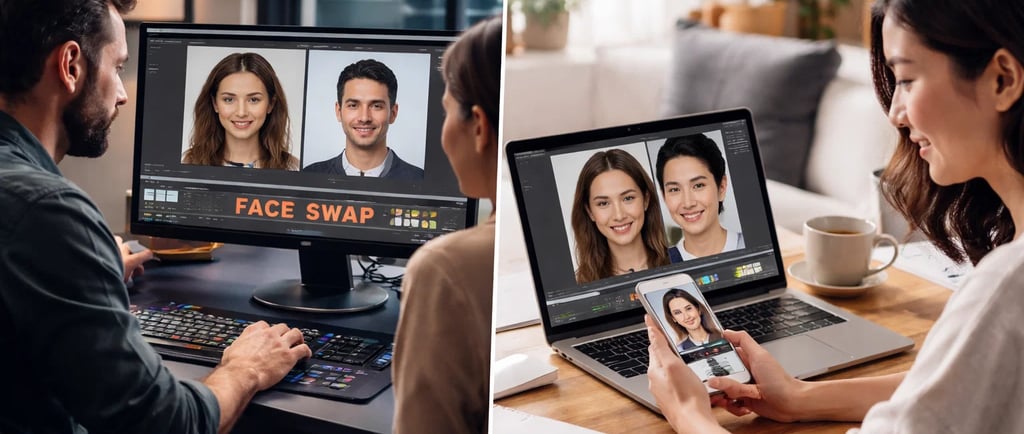
Professional Face Swap Services vs DIY Tools: A Complete Comparison
Face swap technology has become widely accessible, offering users the ability to replace faces in images or videos with increasing realism. As the technology has matured, two distinct approaches have emerged: professional face swap services and do-it-yourself (DIY) tools. While both rely on similar AI foundations, they differ substantially in quality, privacy, reliability, and suitability for different purposes.
Understanding these differences is essential for choosing the right option based on expectations and use case.
Understanding the Face Swap Landscape
Face swapping is driven by artificial intelligence models that analyse facial landmarks, expressions, and proportions, then reconstruct a new face within an existing image or video. Advances in machine learning have made these techniques more accurate and easier to use, contributing to their popularity across entertainment, social media, marketing, and creative industries.
DIY tools are typically designed for speed and accessibility. Many are available as mobile apps or online platforms, allowing users to upload images and generate results instantly. Professional face swap services, by contrast, apply AI within structured workflows that include human oversight, refinement, and quality control.
The choice between these approaches depends primarily on three factors: quality, privacy, and purpose.
Quality and Realism: Where the Difference Is Most Visible
Quality is often the most noticeable distinction between professional services and DIY tools.
Professional face swap services work with high-resolution inputs and focus on realistic integration. Skilled operators refine alignment, adjust lighting, and correct subtle inconsistencies that automated systems may overlook. This results in images that preserve natural proportions, expressions, and visual coherence.
DIY tools, while convenient, usually rely on preset processes. These tools can struggle with complex lighting, unusual angles, or detailed facial expressions. Common issues include unnatural blending, distorted features, and reduced image clarity—especially when working with lower-quality source images.
For casual experimentation, these limitations may be acceptable. For professional or brand-sensitive contexts, they are often not.
Privacy, Consent, and Ethical Responsibility
Privacy and ethical considerations are increasingly important in face swapping. Uploading personal images always involves risk, particularly when users are unaware of how their data is handled.
Professional face swap services typically operate with clearer consent requirements and stricter data handling practices. Images are processed within controlled environments, retained only as long as necessary, and managed according to established privacy standards. This reduces the likelihood of misuse or unauthorised distribution.
DIY tools often provide less transparency. Users may not know whether their images are stored, reused, or shared with third parties. The ease of access can also encourage careless or non-consensual use, which raises ethical and legal concerns.
For projects involving identifiable individuals, public figures, or sensitive content, these differences are critical.
Reliability and Control
Professional services offer a higher level of reliability because they do not rely solely on automated outputs. Human review allows for adjustments, revisions, and contextual judgement. This is especially important when results need to meet specific visual or ethical standards.
DIY tools prioritise speed over control. Users typically have limited options to correct errors or refine outcomes. What the system produces is often the final result, regardless of whether it fully meets expectations.
When consistency and predictability matter—such as in marketing campaigns, creative productions, or client work—professional services provide greater confidence.
Choosing the Right Option Based on Purpose
The intended purpose of a face swap project should guide the choice between professional services and DIY tools. This comparison builds on the broader discussion of face swap tools vs professional services, where quality, privacy, and accountability are examined in more detail.
Professional face swap services are better suited for:
Marketing and advertising campaigns
Creative or artistic projects requiring refinement
Content involving public figures or brand identity
Situations where privacy and consent are critical
DIY tools may be suitable for:
Casual experimentation or personal use
Informal social media content
Low-risk projects where quality is not critical
Matching the tool to the purpose helps avoid unnecessary compromises in quality or responsibility.
Making a Practical Comparison
While both professional services and DIY tools are built on AI face swap technology, they serve different needs. DIY tools offer convenience and immediacy, but often at the cost of realism, control, and privacy safeguards. Professional services prioritise accuracy, accountability, and consistency, making them more appropriate for serious or sensitive applications.
Understanding these trade-offs allows users to make informed decisions rather than defaulting to the most accessible option.
A More Informed Way to Choose
Face swap technology is powerful, but how it is used matters as much as the technology itself. Evaluating quality expectations, privacy requirements, and project goals provides a clearer basis for choosing between professional face swap services and DIY tools.
Selecting the right approach not only improves the final result but also supports more responsible and intentional use of face swap technology.
FaceSwapMe
Private, consent-based AI face and media processing.
Every request is reviewed by a human operator and handled discreetly. Files are deleted after delivery.
© 2026. FaceSwapMe. All rights reserved.
Quick Links
Legal & Privacy
Contact & Availability
contact@face-swap.me
Response time: within 24–48 hours
No data is shared. No content is stored. No processing begins without approval.