Is AI Face Swap Legal? Laws, Consent, and Responsible Use
Is AI face swap legal? Learn how consent, image rights, and data protection laws affect the legal use of face swap technology.
1/26/20263 min read
Is AI Face Swap Legal? Laws, Consent, and Responsible Use
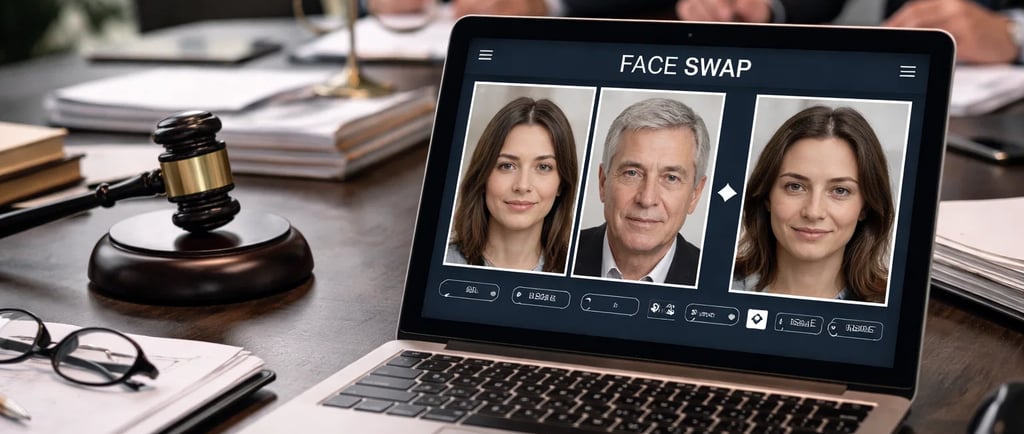
AI face swap technology has advanced rapidly, making it possible to replace a person’s face in images or videos with a high degree of realism. While the technology itself is neutral, its legal implications depend heavily on how, why, and with whose consent it is used. Understanding the legal framework around AI face swap is essential for anyone working with this technology, particularly in professional or commercial contexts.
Understanding AI Face Swap Technology in a Legal Context
Earlier we discussed is face swap safe. AI face swap technology relies on artificial intelligence and deep learning models to analyse and reproduce facial features. By training neural networks—often Generative Adversarial Networks (GANs)—on facial data, these systems learn to recreate faces in a way that closely mimics real expressions, proportions, and lighting.
As the quality of face-swapped content improves, distinguishing between original and manipulated media becomes increasingly difficult. This realism is what makes the technology powerful, but it is also what raises legal and ethical concerns. When a face swap appears authentic, it can affect a person’s identity, reputation, and legal rights if used improperly.
Consent and Image Rights: The Legal Foundation
Certainly face swap privacy is a concern of pretty much everyone. Consent is the cornerstone of lawful AI face swap use. In many jurisdictions, individuals have legal rights over their image and likeness. Using someone’s face without permission—especially in a recognisable or realistic way—can violate privacy rights, image rights, or rights of publicity.
These rights vary by country, but the principle remains consistent: individuals must have control over how their likeness is used. Explicit consent is particularly important when face swaps are created for commercial purposes, public distribution, or sensitive contexts. Without consent, creators and service providers may face legal consequences, including civil claims for damages.
Image rights also intersect with copyright law. If a face swap involves copyrighted material—such as a film scene, promotional image, or protected photograph—additional permissions may be required. Altering or redistributing copyrighted content without authorisation can result in infringement claims, even if the face swap itself was created using AI.
Data Protection Laws and Regulatory Requirements
Beyond image rights, AI face swap technology must also comply with data protection regulations. Laws such as the General Data Protection Regulation (GDPR) in Europe and the California Consumer Privacy Act (CCPA) in the United States impose strict rules on how personal data, including facial images, can be collected, processed, and stored.
Under these regulations, facial images are considered personal data. In some cases, they may even qualify as biometric data, which is subject to heightened protection. This means organisations must have a lawful basis for processing images, inform users about how their data is used, and ensure appropriate security measures are in place.
Failure to comply with data protection laws can result in significant penalties. More importantly, it can undermine trust between service providers and users. Transparency, limited data retention, and secure handling of images are not just best practices—they are legal necessities in many regions.
Ethical Responsibilities and Risk of Misuse
Legal compliance alone is not sufficient to ensure responsible use of AI face swap technology. Ethical considerations play a crucial role, particularly given the potential for misuse. Realistic face swaps can be used to mislead audiences, fabricate events, or damage reputations if applied irresponsibly.
Non-consensual face swaps, misleading representations, and deceptive content raise serious ethical concerns, even if they exist in legal grey areas. The widespread availability of face swap tools increases the risk that such misuse becomes normalised, making ethical standards all the more important.
Responsible use requires clear boundaries: respecting consent, avoiding deceptive contexts, and ensuring that manipulated content is not presented as authentic when it is not. These principles help protect individuals and preserve trust in digital media.
How Professional Face Swap Services Support Legal Compliance
Professional face swap services are typically better equipped to navigate legal and regulatory requirements than fully automated tools. By implementing structured workflows, consent checks, and controlled data handling, professional services reduce the risk of unlawful or unethical use.
Such services often require confirmation that images are used with permission and for legitimate purposes. They also tend to follow established data protection practices, including limited storage periods and secure deletion of images once processing is complete. Human oversight allows for an additional layer of judgement, helping to identify potentially problematic requests before content is produced.
For businesses, creators, or individuals working on sensitive projects, professional services offer a more reliable way to ensure compliance with both legal obligations and ethical expectations.
Making Legally Informed Decisions
AI face swap technology can be used responsibly when legal and ethical considerations are taken seriously. Understanding consent requirements, image rights, and data protection laws helps reduce risk and prevents unintended harm. The more realistic face swap technology becomes, the greater the responsibility to use it thoughtfully.
Choosing solutions that prioritise compliance, transparency, and accountability allows users to benefit from AI face swap technology while respecting individual rights and the legal frameworks that protect them.
FaceSwapMe
Private, consent-based AI face and media processing.
Every request is reviewed by a human operator and handled discreetly. Files are deleted after delivery.
© 2026. FaceSwapMe. All rights reserved.
Quick Links
Legal & Privacy
Contact & Availability
contact@face-swap.me
Response time: within 24–48 hours
No data is shared. No content is stored. No processing begins without approval.